Demand side management
In plain terms
Demand side management (DSM) is the flexibility of (mostly industrial and commercial) processes that can shift their consumption in time — running a cold store, a compressor or a water treatment a bit earlier or later — without changing the total energy used. eDisGo represents this potential as power and energy bands that the optimisation can exploit.
Data
DSM potential is held in DSM, with four time series per
DSM load. The naming is easiest to read as deviations from the baseline load:
p_min— the maximum load decrease (how far consumption may be reduced) at each time step.p_max— the maximum load increase at each time step.e_min— the maximum preponing (energy shifted earlier), cumulative.e_max— the maximum postponing (energy shifted later), cumulative.
These are imported per industrial/CTS load from the OEP with
import_dsm() (see Data sources).
Physics / optimisation
In pm_optimize() (loads listed in flexible_loads) the
DSM bands enter as constraints around the baseline demand \(P_0(t)\):
i.e. the instantaneous shift is bounded by the power band and the accumulated shift by the energy band. The energy band ensures the process still does the same total work — energy is only moved in time, never created or destroyed. The OPF uses this freedom to flatten grid-critical peaks.
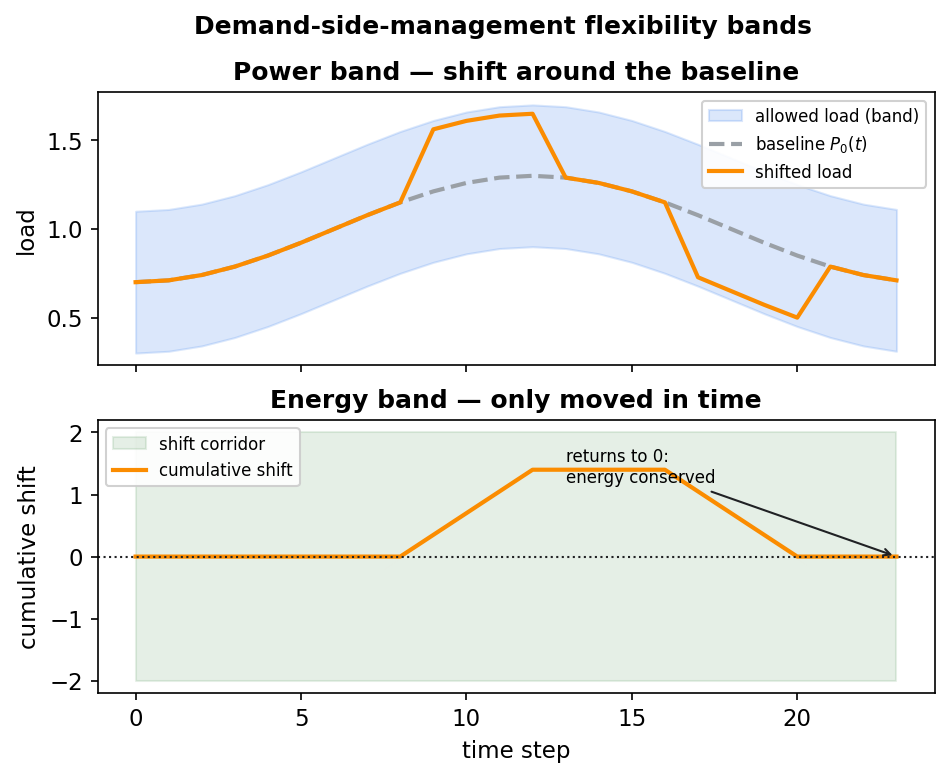
Fig. 10 DSM flexibility bands. The power band bounds the instantaneous shift around the baseline load \(P_0\); the cumulative shift must stay inside the energy corridor and returns to zero, so the same total energy is only moved in time.