Electromobility
In plain terms
Electric vehicles are a large but shiftable load: a car must be charged before it leaves, but when it charges in between can often be chosen freely. eDisGo models this and offers both simple rule-based charging strategies and full optimisation.
Data and allocation
EV data is held in Electromobility:
charging_processes_df— one row per charging event (from SimBEV): use case (home/work/public/hpc), nominal charging power, energy demand, and the park start/end time steps.potential_charging_parks_gdf— candidate charging-point locations (from TracBEV), with a weighting factor.integrated_charging_parks_df— the parks that were connected to the grid (also appear intopology.charging_points_df).
Allocation of charging demand to charging points is done in
distribute_charging_demand(). Private
charging (home/work) gets one charging point per vehicle, selected randomly and
weighted by the TracBEV factor
(distribute_private_charging_demand()).
Public charging is allocated per process: an existing point is reused if it is
free and powerful enough, otherwise a new one is chosen the same weighted way
(distribute_public_charging_demand()).
Grid integration
Once the charging points carry their demand, the parks are connected to the grid by
integrate_charging_parks(). The decisive
quantity is each park’s grid connection capacity, which is deliberately not the
plain sum of its charging-point ratings:
The gross capacity is the summed (loss-corrected) peak power of every charging point in the park (
designated_charging_point_capacity).A size-dependent simultaneity (diversity) factor is applied (
determine_grid_connection_capacity()): parks below 0.3 MW gross are connected in full (factor1.0), parks of 1 MW gross and above are reduced to 45 % (factor0.45), and in between the factor is interpolated linearly. The rationale: the more charging points a site has, the less likely they all draw peak power at the same instant. High-power-charging (hpc) sites are the exception and are connected at full capacity. (Because the linear factor is applied multiplicatively, the resulting capacity is not monotonic in the 0.3–1.0 MW range — see the function’s notes.)The result becomes the charging point’s
p_set, which determines the voltage level it is connected to and how the connection is sized — and hence how much grid reinforcement the charging demand ultimately triggers.
Using the gross sum directly would systematically oversize the connections (and the reinforcement); the diversity factor keeps the integration realistic.
Charging strategies (heuristic)
Rule-based strategies are applied with
apply_charging_strategy()
(charging_strategy()). Every strategy
must fully cover each charging requirement. Only the private use cases — home
and work — are shifted; public and high-power (hpc) charging is always
charged “dumb”, as it prioritises immediate service:
"dumb"— charge at maximum power immediately on arrival. No flexibility; the worst case for the grid."reduced"— preventive: charge at the minimum power that still fully charges the car during its parking time (controlled byminimum_charging_capacity_factor), spreading the load out."residual"— active: charge when the residual load of the grid as a whole (all loads minus all generation and storage, the network-wide quantity) is lowest (high generation, low consumption); processes with little flexibility get priority.
So the "dumb" strategy charges every use case immediately, while "reduced" and
"residual" shift only home and work and leave public/hpc dumb. Either
way, after apply_charging_strategy() every charging point
has an active-power series — none are left unset — which is what a subsequent power flow
or the optimisation needs (the optimisation reschedules only the
charging points passed as flexible and keeps the rest as fixed load).
Note
These grid-friendly charging strategies and their effect on distribution grids were investigated in the master’s thesis underlying this functionality:
Kilian Helfenbein, Analyse des Einflusses netzdienlicher Ladestrategien auf Verteilnetze aufgrund der zunehmenden Netzintegration von Elektrofahrzeugen (in German; “Analysis of the effect of grid-friendly charging strategies on distribution grids due to the increasing grid integration of electric vehicles”), master’s thesis, Hochschule für Technik und Wirtschaft Berlin (in cooperation with the Reiner Lemoine Institut), 2021. PDF
It evaluates the preventive "reduced" strategy (reduced charging power) and the
active "residual" strategy (charging steered by the medium-voltage residual
load) against uncoordinated "dumb" charging on five representative medium-voltage
grids, using SimBEV-derived charging demand. It finds that the "reduced" strategy
reliably lowers load-driven grid issues, whereas the "residual" strategy is the
only one able to reduce generation curtailment in PV-dominated grids — but performs
poorly where the global MV residual load is a weak proxy for local conditions, as in
wind-dominated grids.
Flexibility bands (for optimisation)
For the optimal power flow, each flexible charging point is described by bands
computed with
get_flexibility_bands():
upper_power— the maximum charging power available at each time step (zero when the car is not plugged in).lower_energy/upper_energy— the minimum and maximum cumulative energy that may have been charged by each time step.
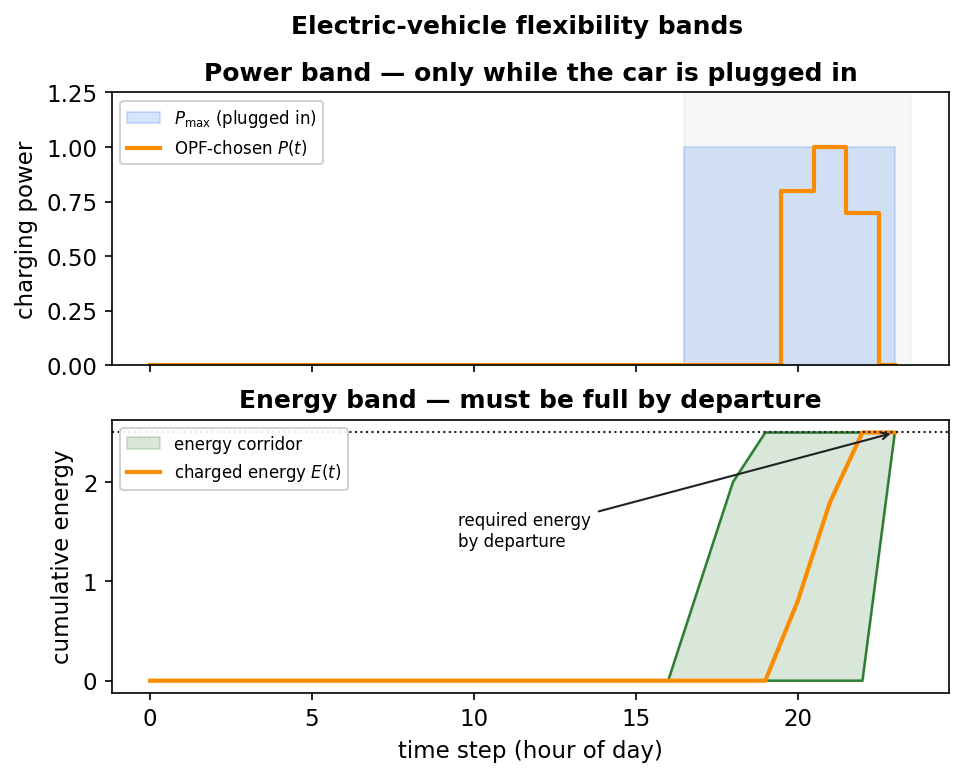
Fig. 8 Electric-vehicle flexibility bands. The power band is non-zero only while the car is plugged in; the energy band guarantees the car is full by departure. The OPF may choose any charging profile that stays inside both bands.
Physics
The bands encode two facts. The power band follows from the connected charger and the parking schedule: \(0 \le P(t) \le P_\text{max}\) only while the car is parked. The energy band guarantees the service: the cumulative charged energy \(E(t)=\sum_{\tau\le t} P(\tau)\,\eta_\text{cp}\,\Delta t\) must reach the required demand by departure and never exceed the battery capacity, i.e. \(E_\text{lower}(t) \le E(t) \le E_\text{upper}(t)\), where \(\eta_\text{cp}\) is the charging-point efficiency. Any operation inside these bands fully serves the user; the OPF picks the grid-friendliest one.
See the Electromobility example notebook for a worked example, and Data sources for how to obtain SimBEV/TracBEV data.