Flexibility & optimisation
In plain terms
Conventional grid planning answers congestion with copper: thicker cables and bigger transformers. But many components in a modern distribution grid can shift their power in time — electric vehicles can charge a few hours later, heat pumps can run when a thermal store has room, batteries can charge and discharge, industrial processes can be moved. eDisGo calls these flexibilities and can schedule them so that the grid stays within limits, reducing or avoiding reinforcement. This part of the documentation explains how each flexibility is modelled and how they are optimised together.
The idea: power and energy bands
Every flexibility is described by bands — limits within which its operation may be moved without violating the user’s needs:
a power band — how much power the component may draw or feed at each time step (e.g. an EV charger’s maximum power while the car is plugged in), and
an energy band — how much cumulative energy must / may have flowed by each time step (e.g. the car must be full before it leaves; a thermal or battery store may not over- or undercharge).
The optimisation is free to choose any operation inside these bands. The bands are what turn “an EV”, “a heat pump” or “a DSM load” into a mathematically optimisable flexibility.
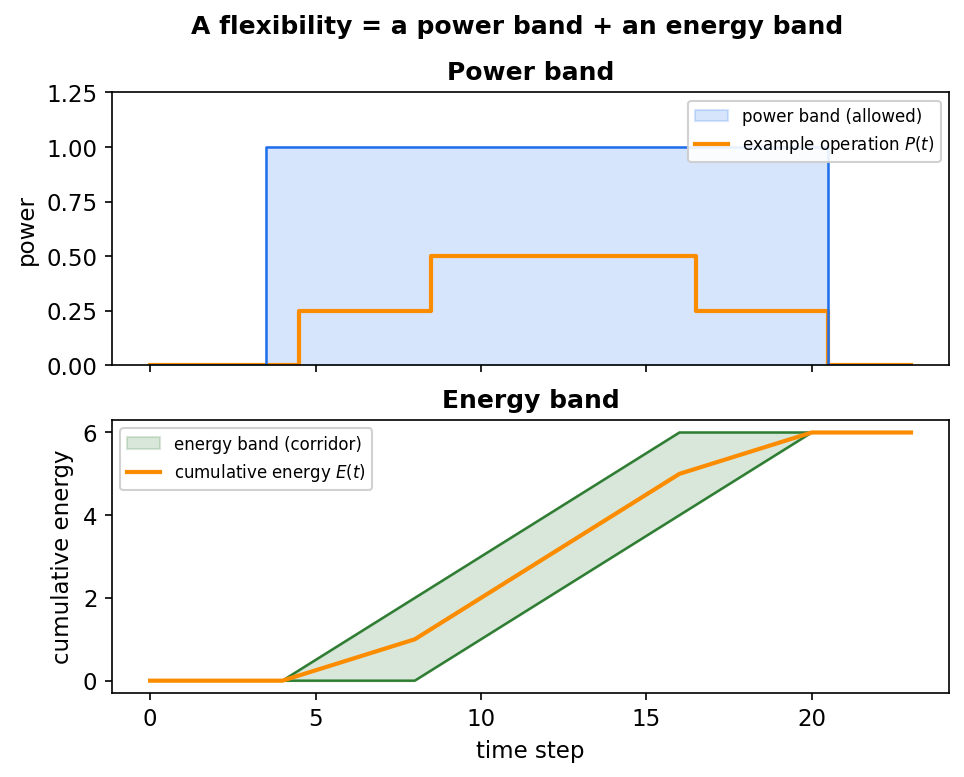
Fig. 3 Every flexibility is expressed as a power band (the allowed power at each time step) and an energy band (the cumulative-energy corridor). Any trajectory that stays inside both bands fully serves the user; the optimisation picks the grid-friendliest one.
The optimise-then-reinforce loop
A typical flexibility study is:
set up the grid, the (inflexible) time series and the flexibilities;
compute the flexibility bands;
run the optimal power flow (
pm_optimize()) to obtain grid-friendly operation schedules;write those schedules back into the time series and reinforce the (hopefully much smaller) residual problems.
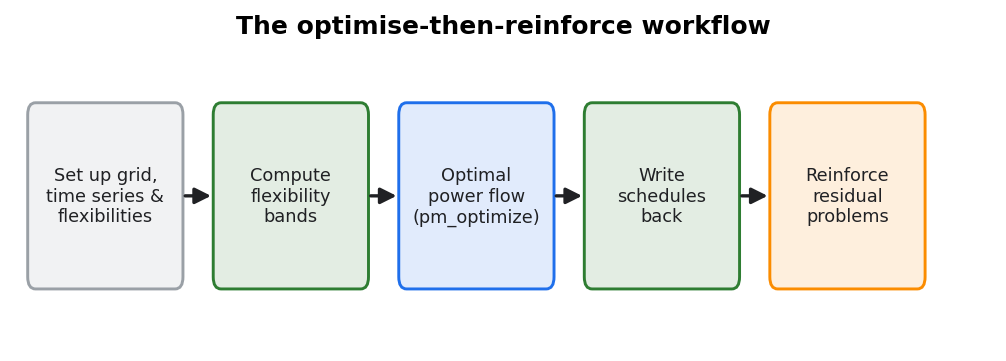
Fig. 4 The optimise-then-reinforce workflow: compute the flexibility bands, schedule the flexibilities with the optimal power flow, write the schedules back, and reinforce only the residual problems.
Comparing the reinforcement cost with and without the optimisation quantifies how much grid expansion the flexibility saves.
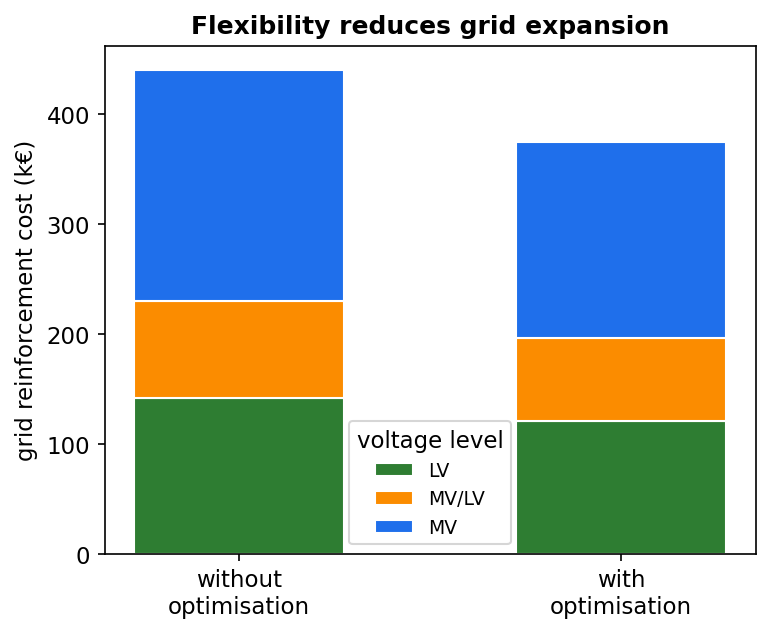
Fig. 5 Reinforcement cost with and without the flexibility optimisation, by voltage level (illustrative). The difference is the grid expansion that the flexibility avoids.
The optimisation model
Step 3 of that loop — the optimal power flow — is the mathematical heart of eDisGo’s flexibility handling. It represents the grid with an AC branch-flow model and, in a single multi-period optimisation, chooses operation schedules for every flexibility that minimise grid stress (line losses and, depending on the settings, line loading, voltage and overlying-grid violations) while keeping each flexibility inside its power and energy bands. Because shifting energy in time only couples components across time steps, all time steps are optimised jointly.
The full formulation — the decision variables, the objective, the branch-flow and flexibility constraints, and how the non-convex AC equations are handled via a second-order-cone relaxation — is described in Multi-period optimal power flow. The model was developed in, and is documented in full mathematical detail in, the master’s thesis it is based on:
Maike Held, Netzdienlich optimaler Einsatz von Flexibilitäten in radialen Verteilnetzen basierend auf einem AC-Lastflussmodell (in German), master’s thesis, Technische Universität Berlin (in cooperation with the Reiner Lemoine Institut), 2023. Publication page
which is the recommended reference for readers who want the complete derivation.
What is flexible
Flexibility |
Container |
Page |
|---|---|---|
Electric vehicles |
||
Heat pumps (+ thermal storage) |
||
Demand side management |
||
Battery / home storage |
|
|
Reactive power |
— |
|
Overlying-grid requirements |
The optimisation that ties them together is described in Multi-period optimal power flow. For all eDisGo component types — grid components as well as these flexibilities — see Components.